
When we think of continuing medical education (CME), formal learning often takes center stage: lectures, webinars, online modules, and required certifications. But here’s a surprising truth—that formal content only accounts for a fraction of how healthcare professionals truly learn and grow.
Enter the 70/20/10 model, a foundational framework in adult learning that reshapes how we design, deliver, and evaluate CME.
What is the 70/20/10 Model
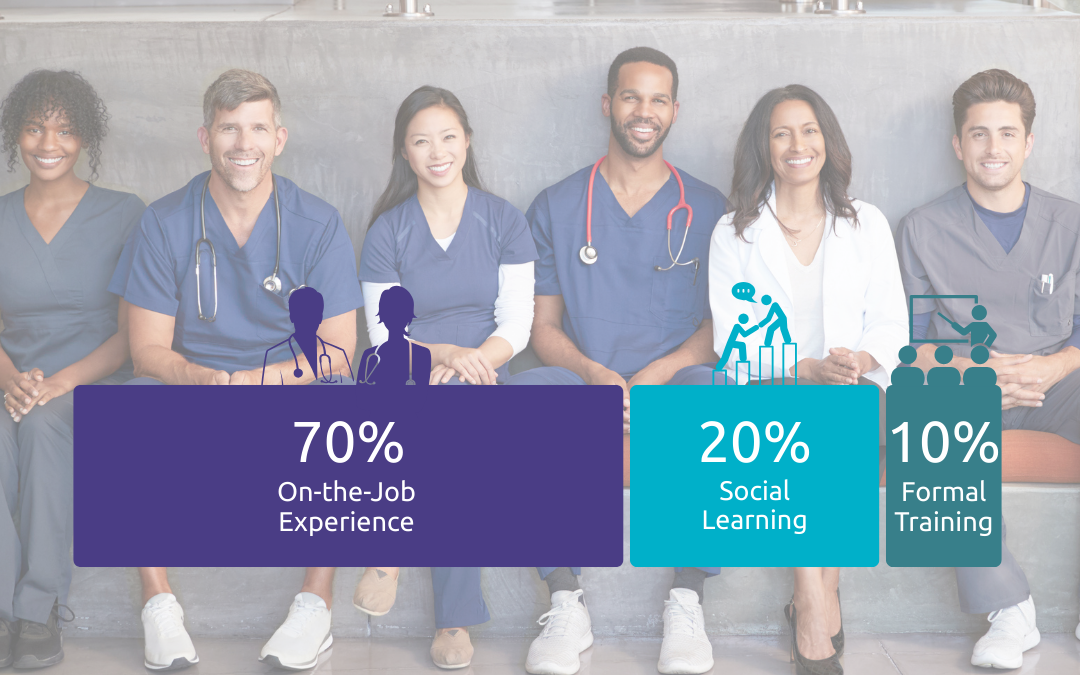
The 70/20/10 model breaks learning into three categories:
-
-
- 70% of learning comes from on-the-job experiences, challenges, and practice.
- 20% comes from social learning, such as coaching, mentorship, and peer feedback.
- 10% comes from formal education, like courses, lectures, and training sessions
-
This model doesn’t minimize the value of formal education—it simply acknowledges that most learning happens outside traditional instruction. Especially in fast-moving, real-world environments like healthcare.
Why It Matters in CME
If we design CME programs that only support the 10%, we’re missing the opportunity to support where 90% of learning naturally occurs.
Think of the 70/20/10 model as a call to action:
-
-
- Are we giving learners room to apply what they learn on the job?
- Are we building structured opportunities for peer interaction?
- Are we supporting the real-time, experience-based learning that happens between formal sessions?
-
When CME reflects the way professionals actually learn, it becomes more engaging, memorable, and impactful.
How to Bring the 70% to Life (On-the-Job Learning)
This is where learners face challenges, try new approaches, and gain confidence through repetition. To support this in CME:
-
-
- Offer scenario-based activities: Simulations, case studies, and simulated patient encounters provide safe environments to practice clinical reasoning.
- Encourage reflective practice: Integrate journaling or guided reflection to help professionals connect content to their daily work.
- Create follow-up tools: Provide action plans or workplace prompts that extend learning beyond the session.
-
The 20%: Learning Through Others
This middle slice is often where the magic happens. Social learning brings nuance, humility, and context to otherwise abstract knowledge.
In CME, social learning can look like:
-
-
- Peer-led discussions: After a formal session, small group breakouts allow learners to share insights and challenges.
- Coaching or mentoring programs: Seasoned professionals guiding newer learners through clinical judgment and career growth.
- Feedback exchanges: Structured opportunities to give and receive peer feedback on communication or clinical skills.
-
The 10% Still Matters—When It’s Done Right
Formal education is not obsolete—but it works best when it aligns with real-world needs.
Instead of passive information dumps, prioritize:
-
-
- Interactive learning: Microlearning, polling, and choose-your-own-path formats keep learners engaged.
- Case-based design: Grounding content in real-life examples makes it more applicable.
- Personalization: Adaptive modules that meet learners where they are (and push them just beyond).
-
Formal learning sets the foundation—but it’s the spark, not the fire.
Benefits of a 70/20/10 CME Approach
When CME embraces the full learning spectrum, we see results:
-
-
- Better retention: Practicing and teaching solidify knowledge far more than passive review.
- More confident clinicians: Real-world application and peer reflection boost self-efficacy.
- Improved patient outcomes: CME grounded in reality leads to behavior change, not just box-checking.
-
Common Pitfalls (and How to Avoid Them)
-
-
- Over-indexing on content: Resist the urge to overload learners with slides. Build time for reflection and connection.
- Underestimating social learning: Don’t assume learners will naturally connect. Facilitate it.
- Lack of application: Without opportunities to practice or reflect, even the best formal content can fade.
-
Final Thoughts: Rethinking CME for the Real World
The 70/20/10 model doesn’t just describe how learning happens—it challenges us to design CME that reflects reality.
By supporting experiential learning, fostering social connection, and delivering high-quality formal education, we move from knowledge delivery to knowledge activation.
Because ultimately, CME isn’t about information. It’s about transformation. And transformation starts with learning that mirrors the lives of those we serve.
Explore our peer-led courses and join a learning group or let us know if you are interested in leading a group of your own. We look forward to seeing you on Gather-ed!